Flight Canceled? Know Your Rights
When an airline cancels or badly delays your flight, U.S. law guarantees one thing: your money back if you decide not to fly.
Other amenities, like meal vouchers and hotels, come from promises the airlines have made. Those promises apply only when the disruption is the airline’s fault.
What the Big Airlines Promise
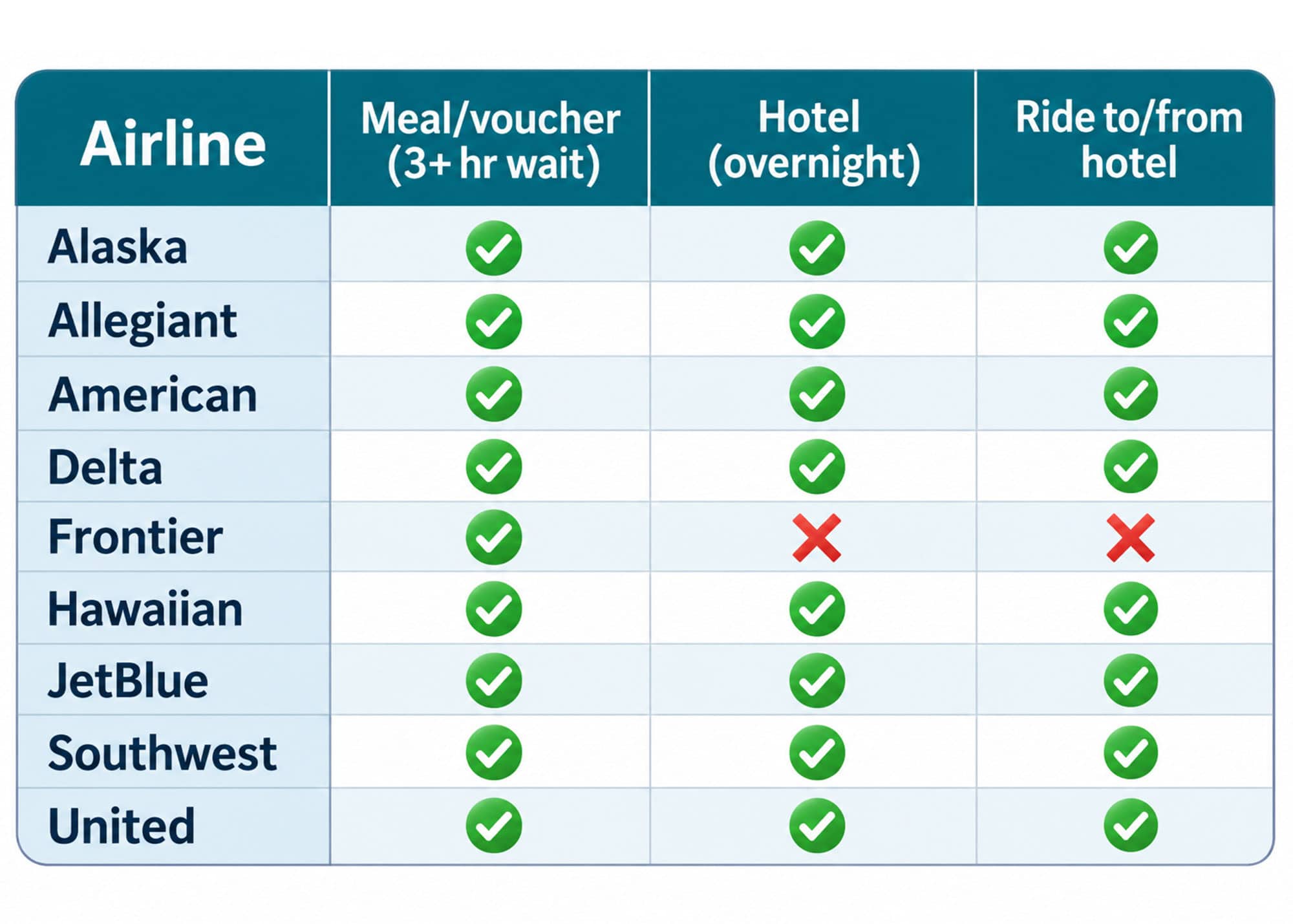
The largest U.S. airlines have posted commitments on the Department of Transportation’s dashboard at flightrights.gov. When a cancellation or long delay is the airline’s fault, every one of them promises to:
- Rebook you for free.
- Give you a meal or meal voucher if you wait 3 hours or more.
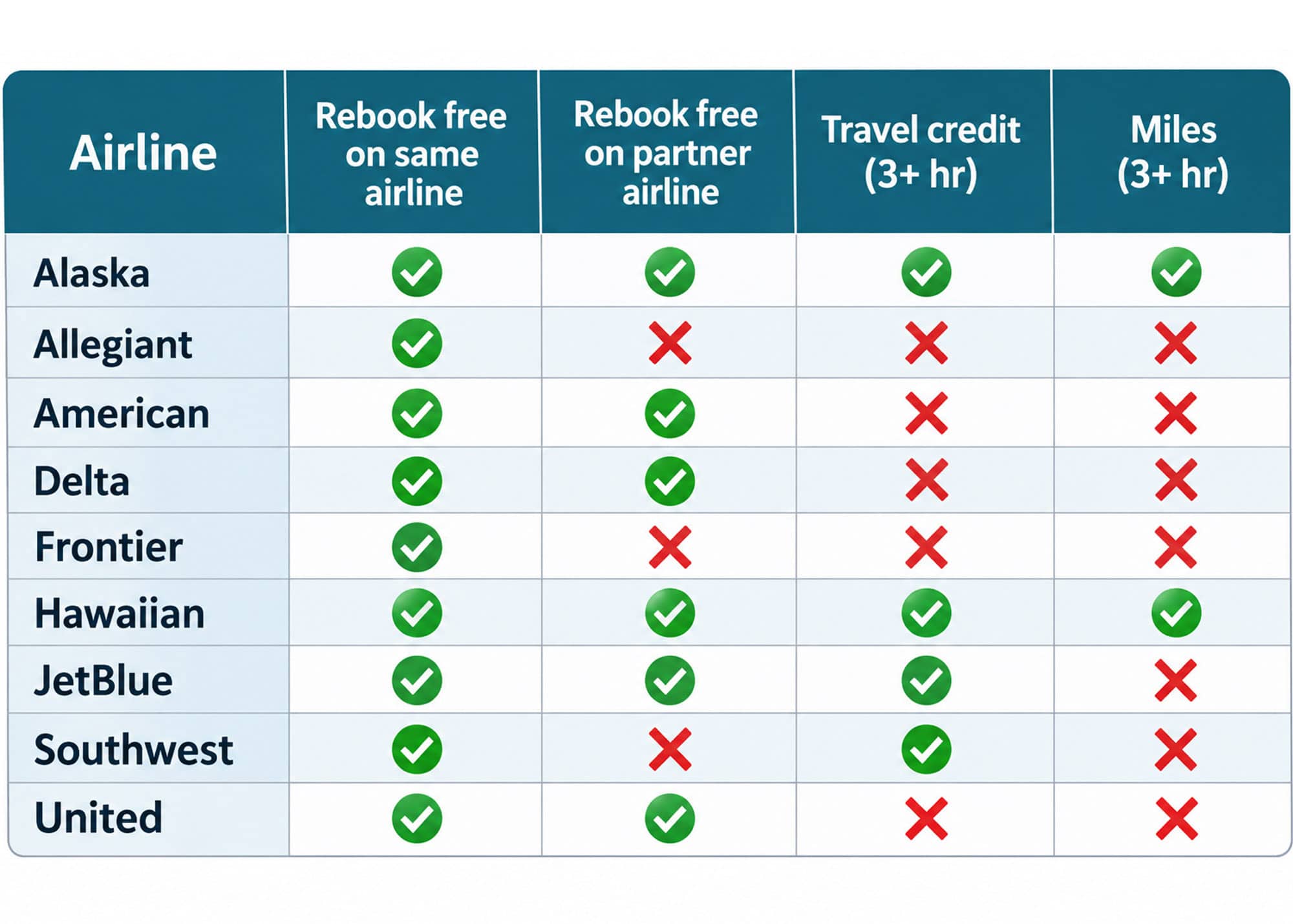
All of them, except Frontier, also promise a free hotel room, plus a ride to and from the hotel, if you’re stuck overnight.
Some go further, with rebooking on partner airlines, travel credits or bonus miles.
An Airline-by-Airline Breakdown:
No law requires these perks, but once an airline writes a promise into its customer service plan, it has to keep it.
Check the dashboard before you fly to see what your airline has committed to.
What Counts as the Airlines’ Fault
DOT calls these “controllable” cancellations and delays, meaning the airline caused them.
Examples include:
- Maintenance problems
- Crew problems
- Cabin cleaning
- Baggage loading
- Fueling
Weather, air traffic control problems such as a ground stop, and security issues don’t count, so the airline’s promises of meals and hotels don’t apply in those cases.
You are still owed a refund if you choose not to fly, whatever the cause.

A Change in 2027
As of February of 2027, 10 kinds of disruption will no longer be counted as the airline’s fault. Congress ordered the change in the FAA Reauthorization Act.
The rule removes 10 types of disruption from the “controllable” category, making it more business-friendly and less consumer/passenger-friendly.
The 10 disruptions:
- Unscheduled maintenance that can’t be put off, including work required by an FAA airworthiness directive
- Aircraft damage caused by extreme weather, debris on the runway, or sabotage
- Overheated brakes after a safety incident that required emergency procedures
- Cyberattacks, if the airline followed cybersecurity rules
- Unexpected failures of government systems needed to fly safely
- Baggage or cargo loading delays caused by an outage of a bag system the airline doesn’t control
- Removing an unruly passenger
- Medical emergencies the airline didn’t cause
- Cleaning the plane after a passenger dies
- Airport closures caused by volcanic ash, wind, or wind shear
Technically, the rule changes how airlines report the cause of a delay. It doesn’t rewrite anyone’s customer service plan.
Since the meal and hotel promises cover only disruptions that are the airline’s fault, fewer delays will qualify, and DOT expects the number of delays that earn those perks to go down. The biggest one for travelers is likely unscheduled maintenance, which is a common reason for delays.
This comes on top of another rollback. In 2025, DOT dropped a Biden-era proposal that would have required airlines to pay cash compensation, starting at $200, for delays and cancellations they caused. No large U.S. airline currently pays cash for delays as a policy.
Refunds for Delays? Yes.
You’re also owed a refund if the airline makes a significant change to your trip and you don’t accept it.
A significant change includes:
- Departing 3+ hours early or arriving 3+ hours late on a domestic flight (6+ hours on an international flight)
- Departing from or arriving at a different airport
- Adding connections to your trip
- Being moved to a lower class of service
What you need to know about refunds
Keep these key points in mind when you’re owed a refund:
- It’s your money, not a credit. The refund goes back to the way you paid. If you paid cash or by card, you get cash back, not a voucher. If you paid with miles, the miles come back.
- Don’t accept the alternative if you want the refund. If you accept the rebooking or the travel credit the airline offers, you give up the refund.
- It has to be fast. Airlines must refund within 7 business days for credit card purchases and 20 days for other payment methods.
- Bag fees count too. If you file a lost-bag report and your checked bag isn’t delivered within 12 hours of a domestic flight (15 to 30 hours for international, depending on flight length), you get the bag fee back.
Cautions & Caveats:
If you cancel on your own, different rules apply.
With a nonrefundable ticket you usually get only what your fare rules allow, often a travel credit, and some basic economy fares get nothing.
One exception: if you booked at least 7 days before departure, you can usually cancel within 24 hours of booking for a full refund.
Expect rebooking, but don’t Expect the extras
No federal law requires airlines to cover hotels, meals, ground transportation or other perks, even if you’re stuck overnight.
In practice, though, most large U.S. airlines promise a meal voucher and a hotel when the disruption is their fault (see above). When the cause is weather or air traffic control, you’re usually on your own.
Advice to Remember:
- Ask why the flight was canceled or delayed. The reason decides what you’re owed.
- Ask for the voucher. Airlines don’t always offer it unless you ask.
- Keep your receipts. If the airline should have covered a meal or hotel and didn’t, you can ask for reimbursement later.
- Check your credit card. Many travel cards include trip delay insurance that pays for meals and hotels when the airline won’t.
Know the tarmac delay rules
If you’re stuck on the plane during a lengthy delay, keep these things in mind:
- The airline has to give you water and a snack within two hours, unless the pilot decides safety or security prevents it.
- They don’t have to give you a full meal.
- Lavatories must work.
- You must get medical attention if you need it.
Know the time limits for getting off the plane
Airlines have three hours on domestic flights and four on international flights to start moving the plane somewhere passengers can safely get off. There are exceptions for safety, security and air traffic control. If you get off, though, you may not be allowed back on.
More Rules for Canceled Flights
A few more rules to remember:
If you’re bumped from an oversold flight
This is one case where cash is required by law.
If you’re bumped involuntarily and the airline can’t get you to your destination within an hour of your original arrival time, you’re owed compensation based on your fare and how late you arrive. You can ask for a check or cash instead of a voucher. If the airline asks for volunteers first, you can negotiate what you’ll accept.
Storms Brewing? Look for travel waivers
During major disruptions, airlines often let you change or cancel without change fees or fare differences.
Check your airline’s travel alerts page. When severe weather is in the forecast, airlines often post waivers a couple of days before the storm hits.
Flying to or from Europe, the UK or Canada?
Those places have their own passenger rights laws, and some require airlines to pay cash compensation for long delays and cancellations.
If your trip involves a flight there, look up the local rules. You may be owed more than U.S. rules provide.
In the last year, I’ve had friends on canceled flights from Paris and London have their entire flight covered, with generous allowances for hotels, meals, and local transportation.
If the airline won’t help
File a complaint with DOT at transportation.gov/airconsumer. Airlines must respond to complaints DOT forwards, and complaints are often what gets a stuck refund moving.
The Insurance Question 🫣
As briefly as possible, these are the general rules I follow. Some people buy insurance for every trip, and that’s fine. Some people never do, and that’s fine, too.
- If it’s an expensive trip, buy insurance
- Don’t buy insurance from the airline when you purchase flights
- Consider an annual plan. I’ve been using this option, partly because I travel a lot and partly because it’s a much better deal. I pay around $200 for the year, and it covers medical, cancelations, and repatriation if I get sick or injured and need advanced care.
Which Travel Insurance to Choose?
I’m not affiliated with any of these options. I’ve purchased Travel Guard for a few years, but (thankfully) never had to use it … so I can’t personally vouch for any of these companies.
Based on NerdWallet, U.S. News, Yahoo Finance, and other consumer advocates, these are the top choices to look at:
- Seven Corners shows up on the most “top insurance” lists. Yahoo Finance ranked it “best for flexible plans.” NerdWallet gives it 4.5 stars and calls it best for mid-trip interruption protection.
- Travel Guard (AIG) is a top pick at Money, and earns 4.5 stars from NerdWallet, which points to its many add-ons for customizing coverage.
- IMG is Yahoo’s pick for transparent coverage and NerdWallet’s best for long-term travelers (4.5 stars), though its wide range of plans can be overwhelming.
- Travelex was a U.S. News best overall winner. It offers a larger-than-average menu of plans, including low-cost options like basic flight insurance.
- Allianz was Yahoo’s best overall, but an earlier NerdWallet review rated it only 3.5 stars and said it costs more than average.
- Trawick is NerdWallet’s best overall at 5.0 stars, for comprehensive coverage at an affordable price. The tradeoff is reports of long claim resolution and lower customer service ratings than top-rated peers.